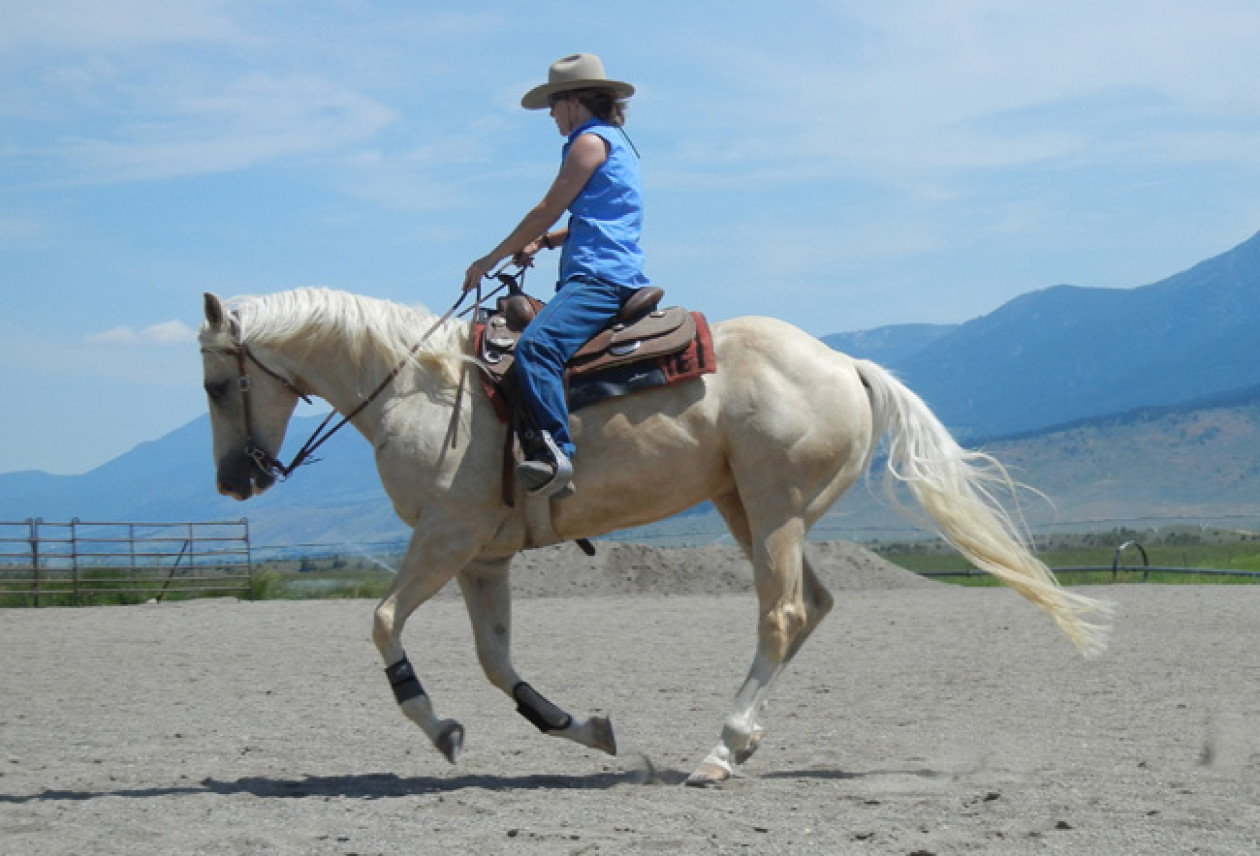
Much of my time is spent filling in the gaps in a horses previous program. I literally start at the beginning, often checking the horse out as if it hadn’t been started under saddle yet.
Many years ago I did a restart on a 14- year- old mare. She had been started at two. She had maybe 10 rides put on her and was never ridden again. Since her routine of the past 12 years was being so dramatically changed, she was pretty bent out of shape when she first came to me. She would kick the walls of her stall and was terribly crabby. I didn’t see a lot to make me think highly of her during her first 30 days of training.
At about 45 days she started to lighten up in every way. It’s not like she gave in, she just mellowed. Life became easier for her and I think she began to actually like it.
She became a dreamboat to lope on. She wasn’t afraid of anything. I could lope across big open hay meadows and she would never change her cadence without being asked to. She would reach a ditch and easily jump it without fear or hesitation. It was such a dramatic change from the first month!
Recently, I was brought a 15-year old-gelding. The owner had purchased him two and a half years ago, yet she had only ridden him a handful of times. She couldn’t get him to move out. On the ground he was spooky, unpredictable and routinely had a short attention span. She would work him on the halter. He would be doing OK and then suddenly spaz out for no apparent reason other than he just couldn’t keep it together any longer.
When I started working with him I found all of this to be true, and then some. Holy Cow! How does a horse get to be this age and have so little training?
My job was to fill in the gaps in his program and work with the owner to advance her skills.
Of course I started at the beginning. I pretty much had to work on everything. Oh, and he couldn’t be tied up. He was afraid of the concrete where I saddle horses and was afraid to walk through the door of the indoor arena.
One entire session was getting him to be more trusting about walking through that door, walking through the door way into the round pen and walking past me with a wall on the other side. This truly was a big deal for this guy.
He very slowly started to improve. When I first started riding him, he was a bit out of control. It was just too much for him. I went back to ground work and confidence building exercises. Once he got better with all of that I was able to start riding again.
It was a similar experience in the saddle in that he would be doing OK, feeling a little bit normal, then spaz out. It would take him a bit to get it back together before we could move on. I realize that saying he “spazed out” isn’t a very descriptive term. It would take way too long to describe the many things he did when he would fall apart. Saying he would “spaz out” will have to cover these curious episodes.
The owner came to the conclusion that she would most likely never ride him. Although, she wanted to keep him in training because she felt that regular interaction was good for him. She could see he was improving.
Well, this is about the time he really started to get it; get with the program, get it together, get his head in the game.
The look in his eye got softer. His head carriage was lower. He wasn’t on high alert quite so much. He became more accepting of being trailer loaded; he wasn’t so nervous. He didn’t goose it when he went through the doorway of the indoor arena. His spaz attacks were getting fewer and farther between. Oh my gosh …… he was becoming somewhat of a normal horse!
I was truly happy for him. What a rotten way to go through life, being so worried about everything.
My “payday” came when the owner was about to take him home. I thought, “well, he’s made it.” He had improved so much that the next logical thing to do was put the owner on him.
I said, “How about it, want to take him for a spin?” She only hesitated for a half a second and said, “sssure”. And by gosh she did it! She rode her horse. All went well. He did one tiny spaz that didn’t even worry her; they recovered right away.
I’m not going to say he had become Prince Charming. I know he’ll have moments here and there where things will fall apart. The thing is, he’ll have a good chance of recovering quicker, may be safer and most likely with a bit less drama.
A few weeks ago I got a call to ride a 17-year-old horse. The complaint was that she was good 80% of the time with the other 20% being quivering wig-outs.
This horse hadn’t been started until she was 11. Can you believe not starting a horse until it is 11 years old?! What was it doing for those 11 years that no one wanted to get on it? Who was happy to feed this horse all those years and get nothing in return?
I don’t know that much about the history of this horse; I just know that she really likes people and really likes to be ridden.
The issues I’ve been asked to resolve include teaching her to stand when mounted. She has the habit of moving out quickly just as soon as your foot puts weight in the stirrup. Also, she gets pretty excited when she is with other horses. She comes unglued when she gets very far away from the horse or horses she is riding with.
As always, I start at the beginning. Her skills with ground work pretty much passed with flying colors. I take it as a good sign. But I’ve seen it before where they are good on the ground and whirling dervishes in the saddle. That scenario isn’t common, but it happens.
I get to work. I start with teaching her to be mounted from the fence. I need to break the habit of her taking off when she feels weight in the stirrup. Over and over I set her up next to the fence; she walks off and we start up again. I lead her by me and set her up again. Over and over and over we do this.
The first two days this is all I get done. When she does well enough for me to commit to getting on, I enter into the next phase of waiting on me when I sit in the saddle. As soon as I get on she walks off. I bring her back to the fence and start up again. I sit and really relax so she wonders what I’m doing. She gets impatient, walks off and I bring her back and start up again. Eventually, it sinks in that she doesn’t need to leave.
Everything I do with her is about consistency, repitition and being patient. I don’t keep track of my time and don’t look at my watch. It doesn’t bother me that we do it over and over again. About the only thing I ever care about is if the horse isn’t trying to work with me. I’m not as thrilled with a horse that doesn’t have much try.
Having said that, this mare does get better every day and you just can’t beat that.
Once this mare is consistently standing still while I mount I move on to mounting from a mounting block. A mounting block is an inbetween stage from mounting from the fence to mounting from the ground.
I go through the same procedure of set it up, enter up and if she moves off, lead her around to start up again. No big deal. I give her the chance to do it right. If she can’t make it, I start up again.
Eventually, I mount from the ground. Because mounting from the block is so similar to her, she’s well prepared for me to mount from the ground. She makes a few mistakes, but overall, this goes really well. From now on she’s being mounted from the ground, mostly without issue.
Yes, this is a process, but that’s what I’m here for. If you were watching me it might remind you of waiting for paint to dry. It doesn’t bother me how long it takes as long as the horse tries to work with me. As long as they have some “try,” I’m good with it. You want to take the time that it takes. It’s as simple as that.
While I’m doing this basic procedure (mounting from the fence, the mounting block, then the ground) the horse is gaining a mindset; that I am here for them, am consistent, will support them and will wait until they get it right. Then I will give them relief, release, a recess or whatever you like to call it.
This applies to all training of horses. It is of utmost importance when working with a troubled or misguided horse.
Back to the the seventeen-year-old mare. The bottom line is that in the past she was ridden, yet she wasn’t truly broke. When a horse is given a brief or minimal education and then asked to do speed or advanced maneuvers, it becomes frustrated, sometimes scared and often resistant. So, when you find yourself running into trouble with a horse you have to go back to the basics and it’s foundation. Narrow it down to what is missing in that foundation, then build back up to the maneuver that was making the horse fall apart. Be patient and consistent and that horse will show you just how good they can be.
Regressions are normal. Remember that working with horses isn’t a 21st century instant gratification occupation. And yet, if you take your time, it actually can be.
Two weeks ago I was brought a ten-year-old gelding that had gotten, what the owner called, spoiled. It could no longer be ridden away from the barn and it’s pals. I didn’t get much more information other than that.
He’s a big fellow and obviously unsure of himself; he lacks self confidence. He becomes agitated at the hitch rack; he’s in a hurry. He doesn’t know where he’s gotta go, but he’d best get going there quickly.
I go about my business of checking him out. I see what he can do and find out what’s missing.
I see that he’s not really connected to his feet. When I ask him to move out loose in the round pen, he’s not connected to me either. On the halter or loose he thinks he should make the decisions. He trots without me asking and tries to face up to me with no invitation. He doesn’t have a clue of how to read me. When I ask him to change directions, it’s a big surprise to him. Then he boogers when he sees me out of the new eye, like, “WHOA, where did you come from!!!”
This is so typical of horses that are insecure. They don’t want to be the leader and when forced to, they dislike it immensely. This is where most “problem” horses get their bad rap. All they really want is direction and consistency from their rider. When they don’t get direction and leadership it is a tough deal for them to take.
After a while he can cross a tarp. He’s good with his feet, good to saddle, good to bridle and not too bad with the flag. I like all that. It gives me the chance to focus more on the root of the things he’s not good at.
I spend the whole first week in the round pen showing him how to connect to the human and how to wait on some direction from me. He’s really quite troubled, so it doesn’t come quickly.
When I start riding him I see how light mouthed he is. When I pick up on the rein to direct him his whole mouth and nose cringe. Boy, does he dislike contact. After a little time he realizes that I will connect with his mouth and then leave him alone. Although, he doesn’t feel much on the first ride because he’s so busy being worried and anxious. I had to spend a few more days repeating this before he got it all figured out and let down a little bit.
The first time I ride him in the outdoor arena, I choose to do it when I’m teaching a lesson. If things go to heck, I’ll just put him up and go back to teaching without him. It works out fine, in a fashion. He could not quit moving his feet the whole lesson, so I didn’t ask him to. I would just circle the student and keep talking/teaching on the move. All I asked of him was to give to the bit for directional guidence. I just let him move and do what he needed to do as long as it was at the walk. I kept it really simple.
Even after an hour he wasn’t really ready to stop. I kept asking until I got the feet stopped. I normally wait until they get relaxed and take a breath before I get off, but there was no way that was going to work with this guy. I may well have waited till midnight for that to happen. I got the feet stopped, rubbed his neck and dismounted.
He had the look of utter surprise when I got off. He looked at me as if to say, “that’s it, that’s all you’re going to do?!” He shook his head and neck, worked his mouth and shook a few more times. He visibly processed the information and for the most part, quietly walked behind me back to the barn.
My next ride I ask more. I also asked for a soft feel from him. He hadn’t been ready before this. Now he was ready and gave me hints of what I would get in the coming days.
Again, I rode him while teaching. I did this on purpose so that I wouldn’t be tempted to train on him too much. The next ride was my “Payday” ride. He was a different horse. He sat still for extended periods of time, willingly, while I watched my student loping. He regularly gave a soft feel. I could move his body around without his mind and feet getting anxious. It’s such a wonderful feeing to experience this, probably even more so for him than me.
I’ll have this boy for a while as I still have to work with the rider once I’ve got him consistently happy. I’ll be asking a lot more of him over the next few weeks. It will be hard for him, because every day I’ll ask him to go a little bit further out of his comfort zone, but only as much as he can handle. I’ve seen a glimmer of what is underneath this boy’s skin and I like it!
Sent from my iPad